donderdag 22 september 2011

America and Europe are on the verge of disastrous recession

Interest rates on US, German and UK government bonds have fallen to all-time lows. Yields on 10-year US Treasury securities, for example, are below 2 per cent. That is the lowest recorded since the Federal Reserve began publishing market data in 1953. In addition, yields on the inflation-protected 10-year Treasuries are zero. These are almost incomprehensible levels whose implications are profoundly negative. Namely that Tuesday’s International Monetary Fund report is quite correct to warn that America and Europe are on the verge of renewed recession. It is only the anticipation of negligible demand for capital and negligible inflation – both hallmarks of recession – that could drive rates this low.
For the American and western European economies to decline again, when unemployment levels are already so high, would be disastrous. It would shock consumers, businesses and financial markets. Fearful, they would retrench further, causing the economic decline to accelerate. Weak labour markets would worsen as would the already swollen government deficits and debt. Overall, we could be in for a repeat of the experience of 1937, when America fell back into recession after three years of recovery from the Great Depression.
How do we know that another recession is approaching? For starters, there is no other credible explanation for the relentless fall in interest rates. Yes, monetary policy is on maximum ease and that controls short-term rates. Safe haven psychology also is at work. However, these cannot explain such low yields on longer-term government and corporate bonds. Further, bond markets usually signal recession through an inverted yield curve, when long-term rates are lower than short-term ones. Technically, this is impossible now given short-term rates are zero. But the recent movement in long-term rates is the equivalent.
Moreover, recent US and European economic data convey serious weakness. US household net worth has begun to fall again and jobless claims have been rising for several weeks. Retail sales are flat and consumer confidence is hovering around modern lows. Onshore corporate liquidity has reached a record $13,000bn, which signals that businesses are uncertain over the outlook.
Across the Atlantic, the trend is also poor. Neither Germany nor France grew in the second quarter. Household consumption in the eurozone actually fell during that period. Moreover, the European Commission is forecasting only 0.2 per cent and 0.1 per cent growth across the region for the third and fourth quarter respectively. The worsening of the sovereign debt crisis surely means that actual results will be worse.
It is the debilitating sovereign debt crisis in Europe that is pushing both regions back towards the brink. It is causing credit conditions to tighten again for sovereign credits, weaker borrowers and small and mid-sized business. It also is suppressing consumer and business confidence and the export outlook.
The never-ending nature of this crisis was avoidable. At every opportunity Europe’s leaders have delayed, taken the tiniest steps possible and generally averted their eyes to the elephants in the room. Yes, everyone knows that the country-by-country politics are difficult, starting with Germany. But the risk of another Lehman-like market collapse and subsequent economic contraction is huge. Faced with this, European leaders must confront the politics. Instead, their grudging incrementalism is deepening the risks. Implicitly, this was the message behind Treasury Secretary Geithner’s presence in Poland last week.
A single currency representing 17 separate nations inevitably requires a unified balance sheet behind it and, following that, a form of fiscal union. The time for denying the latter is over. The European financial stability facility must be enlarged exponentially so that it can stand behind nations such as Italy or Spain. In addition, the mandate of the European Central Bank must be expanded. Just like the Federal Reserve, it should be responsible for maintaining a sound banking system and stable capital markets. This requires a permanent capacity to finance banks directly, just as a group of central banks did last week. It also requires the flexibility to buy and sell sovereign debt securities in secondary markets. These reforms must be accompanied by tighter, eurozone-wide bank regulation and supervision. It also requires IMF-like conditionality to accompany direct EFSF loans to member nations. Finally, the ECB should ease monetary policy now as there is no visible inflation risk.
America also must stop its own partisan bickering and undertake one last round of fiscal stimulus. The $447bn job-creation plan by President Obama, or another quick-acting plan of similar magnitude, should be enacted immediately. The Fed should also initiate further moves to promote credit availability and lending.
Another recession would be profoundly damaging to labour markets and public confidence. It would take years to fully overcome. We must try to avoid such an outcome at all costs. That requires the type of far-sighted leadership that we haven’t seen much of lately.
The writer is founder and chairman of Evercore Partners and former US deputy Treasury secretary under President Bill Clinton

Response by Peter Spiegel
The EU is hoping structural reforms can stave off a double-dip
While Roger Altman is right that national politics has hampered a European response to the ongoing debt crisis, there is a mounting realisation in Brussels and elsewhere on the continent that the constant drumbeat for austerity risks pushing the European Union into a double-dip recession.
Olli Rehn, the European Union’s economic chief, has in recent weeks taken to imploring countries with room to manoeuvre to start implementing the kinds of jobs and growth-promoting policies Mr Altman advocates – though instead of using fiscal stimulus, as the Obama administration is proposing, he has argued that structural reforms, particularly wholesale economic liberalisation, can do the trick. As Mr Rehn recently told the European Parliament, “The scope of macroeconomic stimulus is very limited – nonexistent in many member states - [so] growth-enhancing structural reforms have become even more central.”
-- The writer is FT’s Brussels bureau chief

donderdag 8 september 2011

20 Quotes From European Leaders That Prove That They Know That The Financial System In Europe Is Doomed

The financial crisis in Europe has become so severe that it has put the future of the euro, and indeed the future of the EU itself, in doubt. If the financial system in Europe collapses, it is going to plunge the entire globe into chaos. The EU has a larger economy and a larger population than the United States does. The EU also has more Fortune 500 companies that the United States does. If the financial system in Europe breaks down, we are all doomed. An economic collapse in Europe would unleash a financial tsunami that would sweep across the globe. As I wrote about yesterday, the nightmarish sovereign debt crisis in Europe could potentially bring about the end of the euro. The future of the monetary union in Europe is being questioned all over the continent. Without massive bailouts, there are at least 5 or 6 nations in Europe that will likely soon default. The political will for continued bailouts is rapidly failing in northern Europe, so something needs to be done quickly to avert disaster. Unfortunately, as anyone that has ever lived in Europe knows, things tend to move very, very slowly in Europe.

If the bailouts end and Europe is not able to come up with another plan before then, mass chaos is going to unleashed. Most major European banks are massively exposed to European sovereign debt, and most of them are also very, very highly leveraged. If we see nations such as Greece, Portugal and Italy start to default, we could have quite a few major European banks go down in rapid succession. That could be the "tipping point" that sets off mass financial panic around the globe.

Of course the governments of Europe would probably step in to bail out many of those banks, but when the U.S. did something similar back in 2008 that didn't prevent the world from plunging into a horrible worldwide recession.

Right now, the way that the monetary union is structured in Europe simply does not work. Countries that are deep in debt have no flexibility in dealing with those debts, and citizens of wealthy countries such as Germany are becoming deeply resentful that they must keep shoveling money into the financial black holes of southern Europe.

These bailouts cannot go on indefinitely. Political and financial authorities all over Europe know this and they also know that Europe is rapidly heading toward a day of reckoning.

The quotes that you are about to read are absolutely shocking. In Europe they openly admit that the financial system is dying, that the euro is in danger of not surviving and that the EU does not work in its present form.

The following are 20 quotes from European leaders that prove that they know that the financial system in Europe is doomed....

#1 Polish finance minister Jacek Rostowski: "European elites, including German elites, must decide if they want the euro to survive - even at a high price - or not. If not, we should prepare for a controlled dismantling of the currency zone."

#2 Stephane Deo, Paul Donovan, and Larry Hatheway of Swiss banking giant UBS: "Under the current structure and with the current membership, the euro does not work. Either the current structure will have to change, or the current membership will have to change."

#3 EU President Herman Van Rompuy: "The euro has never had the infrastructure that it requires."

#4 German President Christian Wulff: "I regard the huge buy-up of bonds of individual states by the ECB as legally and politically questionable. Article 123 of the Treaty on the EU’s workings prohibits the ECB from directly purchasing debt instruments, in order to safeguard the central bank’s independence"

#5 Deutsche Bank CEO Josef Ackerman: "It is an open secret that numerous European banks would not survive having to revalue sovereign debt held on the banking book at market levels."

#6 ECB President Jean-Claude Trichet: "We are experiencing very demanding times"

#7 International Monetary Fund Managing Director Christine Lagarde: "Developments this summer have indicated we are in a dangerous new phase"

#8 Prince Hermann Otto zu Solms-Hohensolms-Lich, the Bundestag's Deputy President: "We must consider whether it would not be better for the currency union and for Greece itself to go for debt restructuring and an exit from the euro"

#9 Alastair Newton, a strategist for Nomura Securities in London: "We believe that we are just about to enter a critical period for the eurozone and that the threat of some sort of break-up between now and year-end is greater than it has been at any time since the start of the crisis"

#10 Former German Chancellor Gerhard Schroeder: "The current crisis makes it relentlessly clear that we cannot have a common currency zone without a common fiscal, economic and social policy"

#11 Bank of England Governor Mervyn King: "Dealing with a banking crisis was difficult enough, but at least there were public-sector balance sheets on to which the problems could be moved. Once you move into sovereign debt, there is no answer; there's no backstop."

#12 George Soros: "We are on the verge of an economic collapse which starts, let's say, in Greece. The financial system remains extremely vulnerable."

#13 German Chancellor Angela Merkel: "The current crisis facing the euro is the biggest test Europe has faced for decades, even since the Treaty of Rome was signed in 1957."

#14 Stephane Deo, Paul Donovan, and Larry Hatheway of Swiss banking giant UBS: "Member states would be economically better off if they had never joined. European monetary union was generally mis-sold to the population of the Europe."

#15 Professor Giacomo Vaciago of Milan's Catholic University: "It's clear that the euro has virtually failed over the last ten years, even if you are not supposed to say that."

#16 EU President Herman Van Rompuy: "We’re in a survival crisis. We all have to work together in order to survive with the euro zone, because if we don’t survive with the euro zone we will not survive with the European Union."

#17 German Chancellor Angela Merkel: "If the euro fails, then Europe fails."

#18 Deutsche Bank CEO Josef Ackerman: "All this reminds one of the autumn of 2008"

#19 International Monetary Fund Managing Director Christine Lagarde: "There has been a clear crisis of confidence that has seriously aggravated the situation. Measures need to be taken to ensure that this vicious circle is broken"

#20 German Chancellor Angela Merkel: "The euro is in danger ... If we don't deal with this danger, then the consequences for us in Europe are incalculable."

Most of the individuals quoted above desperately want to save the euro. They are not going to go down without a fight. The overwhelming consensus among the political and financial elite in Europe is that increased European integration in Europe is the answer.

For example, EU President Herman Van Rompuy is very clear about what he believes the final result of this crisis will be....

"This crisis in the euro zone will strengthen European integration. That is my firm belief."

Many of the elite in Europe are now openly talking about the need for a "United States of Europe". Just consider what former German chancellor Gerhard Schroeder recently had to say....

"From the European Commission, we should make a government which would be supervised by the European Parliament. And that means the United States of Europe."

But as mentioned above, things in Europe tend to move very, very slowly. The debt crisis in Europe is rapidly coming to a breaking point, and it is very doubtful that Europe will be able to move fast enough to head it off.

What we may actually see is at least a partial collapse of the euro and a massive financial crisis in Europe first, and then much deeper European integration being sold by authorities in Europe as "the solution" to the crisis.

This would be yet another example of the classic problem/reaction/solution paradigm.

The "problem" would be a horrible financial crisis and economic downturn in Europe.

The "reaction" would be a cry from the European public for someone to "fix" things and return things back to "normal".

The "solution" would be a "United States of Europe" with much deeper economic and political integration which is something that many among the political and financial elite of Europe have wanted for a long, long time.

Right now, the people of Europe are very much opposed to deeper economic and political integration. For example, 76 percent of Germans says that they have little or no faith in the euro and one recent poll found that German voters are against the introduction of "Eurobonds" by about a 5 to 1 margin.

It looks like it may take a major crisis in order to get the people of Europe to change their minds.

Unfortunately, it looks like that may be exactly what is going to happen.

zondag 10 juli 2011

Get ready for the North American gas shock

In this era of global bubble-blowing we have seen speculative fever flourish in relation to many different asset classes. At the peak of a bubble the euphoria can be palpable, and the perception that 'it's different this time' confers a sense of invulnerability that justifies throwing caution to the wind.

Speculators cease to worry about how much they pay for an asset, since they think someone else will always pay more later. Unfortunately for those caught up in powerful swings of herding behaviour, it's never different this time. Boom inevitably turns into bust, because the supply of Greater Fools is not infinite after all.

Speculative financial flows seeking 'alpha' can overwhelm important sectors of the real economy. Price, driven by perception rather than by reality, significantly over-reaches the fundamentals. Demand is artificially brought forward. That apparent demand drives considerable mal-investment and a pathological level of risk-taking. When the bubble reaches its maximum extent and implodes, speculation moves into reverse and the sector is dumped.

The artificial demand stimulation disappears, leaving a demand vacuum. The scale of the mal-investment becomes obvious, and prices head for a significant undershoot of the fundamentals. A bubble that created virtual wealth temporarily, leaves very real economic wreckage in its wake. When a critical economic sector is affected, the fallout can be very painful.


We have been witnessing just such a dynamic playing out in the North American natural gas market in recent years, with a particular focus on the shale gas that is touted as being the key to energy independence. The hype over a supposed 100 year supply of cheap, clean energy has been pervasive. Vast sums of money have been committed as a result, despite very little critical evaluation of the real world prospects, at least in the public domain.

Thankfully there have been a few sober voices in the wilderness who were prepared to challenge the received wisdom, most notably Arthur Berman (whose superb work can be found at The Oil Drum) and Canadian gas expert David Hughes.

Conventional supplies of natural gas peaked 10 years ago, and concern over supply began a few years later. Considering that natural gas provides some 20% of electricity and 60% of home heating (more in the north east), it is not surprising that apparently imminent supply problems would have been a cause for concern. A particularly good review of the situation at the time can be found in Julian Darley's 2004 book High Noon for Natural Gas.

Unconventional gas sources (shale gas, coal bed methane and tight formation gas) have since appeared to be game-changers, and game-changers can restore complacency remarkably quickly. But, appearances can be deceiving, and complacency is dangerous.

Energy independence is the Holy Grail of what passes for energy policy in the US. The last 8 presidents have all stressed its importance, but none has been able to do anything about a growing dependence on energy imports, many from unstable parts of the world, or from energy exporters with increasing domestic demand who are well along the depletion curve themselves. There have been speeches on the value of ethanol and other biofuels, along with incentives for their production, but a conviction that energy independence might actually be achievable only really seemed to emerge with in recent years in relation to shale gas.

Apart from the policy windfall, an apparent gas bonanza offered the potential for lucrative financial returns (especially on land speculation), and it allowed environmental organizations to support gas as a transitional fuel on the path to a renewable energy future. Across the board support for shale gas was virtually guaranteed. However, strong consensus is always a red flag, as we have discussed many times here at The Automatic Earth. The stronger the consensus, the more it pays to question what so many uncritically hold to be true. It is clearly time to take a more in-depth look at the real prospects for natural gas in North America.


Geologist Arthur Berman has been the most prominent public critic of shale gas. His major points of contention lie in the companies 'manufacturing model', their extrapolation of gas reserves, the implication of rapid decline rates, and the destruction of shareholder value as the numbers simply do not add up. The 'manufacturing model' utilized by the gas companies asserts that all parts of a gas play are equal, so that one may drill anywhere with comparable success. Extrapolating from the few most successful wells yields reserve estimates that Mr Berman feels are hugely inflated. He demonstrates that all shale gas plays contract to a core area, typically representing no more than 10-20% of the original area.


In addition to there being relatively few 'sweet spots' in shale plays, Mr Berman also points out that shale gas wells show much more rapid depletion rates than conventional natural gas wells (65-85% in the first year, as compared to 25-40%), and that this has an inevitable impact on extrapolations of recoverable gas supplies.

In his view, the shale gas resource is vastly less than the estimates that have entered the public consciousness:
I recently grouped all the Barnett wells by their year of first production. Then I asked, of all the wells that were drilled in each one of those years, how many of them are already at or below their economic limit? It was a stunning exercise because what it showed is that 25-35% of wells drilled during 2004-2006 - wells drilled during the early rush and that are on average 5 years old-are already sub-commercial. So if you take the position that we’re going to get all these great reserves because these wells are going to last 40-plus years, then you need to explain why one-third of wells drilled 4 and 5 and 6 years ago are already dead [..]

If you investigate the origin of this supposed 100-year supply of natural gas…where does this come from? If you go back to the Potential Gas Committee’s [PGC] report, which is where I believe it comes from, and if you look at the magnitude of the technically recoverable resource they describe and you divide it by annual US consumption, you come up with 90 years, not 100. Some would say that’s splitting hairs, yet 10% is 10%. But if you go on and you actually read the report, they say that the probable number-I think they call it the P-2 number-is closer to 450 Tcf as opposed to roughly 1800 Tcf.

What they’re saying is that if you pin this thing down where there have actually been some wells drilled that have actually produced some gas, the technically recoverable resource is closer to 450. And if you divide that by three, which is the component that is shale gas, you get about 150 Tcf and that’s about 7 year’s worth of US supply from shale. I happen to think that that’s a pretty darn realistic estimate. And remember that that’s a resource number, not a reserve number; it has nothing to do with commercial extractability. So the gross resource from shale is probably about 7 years worth of supply.


Stoneleigh: Consistently disappointing results have not so far burst the shale gas bubble, as people seem all too willing to believe the hype without question. This lack of critical thinking is characteristic of bubble psychology. Bubbles are formed as an interaction between predators and willing victims blinded by greed. It's important to remember that it's never 'different this time'.

Art Berman:
Shale play promoters constantly try to divert attention and analysis from current plays to newer plays. Newer plays have less data to analyze and, therefore, reserve claims are more difficult to question. Because the Barnett and Fayetteville shale plays have under-performed expectations, we were invited a few years later to consider the future potential of the Haynesville Shale play.

Now that the Haynesville looks disappointing, we are asked to consider the Marcellus Shale play. Since the State of Pennsylvania does not publish monthly production data for analysts to evaluate, no one can dispute or confirm the claims made by operators. With the shift to liquids-rich plays like the Eagle Ford Shale, we are again asked to trust the same promoters that sold us under-performing plays in the past that this time it will be different.


Stoneleigh: The shale gas bubble is a perfect example of the irrationality of markets, the power of perverse short-term incentives, the driving force of momentum-chasing, the dominance of perception over reality in determining prices, and the determination for a herd to stampede over a cliff all at once. The perception of a gas glut has driven prices so low that none of the participants are making money (at least not by producing gas) or creating value. We see a familiar story of excessive debt, and the hollowing out of productive companies dead set on pursuing a mirage.

Art Berman:
It’s all about production numbers. They call these things asset plays or resource plays; that reflects where many are coming from, because they’re not profit plays. The interest is more in how big are the reserves, how much are we growing production, and that’s what the market rewards. If you’re growing production, that’s good-the market likes that. The fact that you’re growing production and creating a monstrous surplus that’s causing the price of gas to go through the floor, which makes everybody effectively lose money….apparently the market doesn’t care about that. So that’s the goal: to show that they have this huge level of production, and that production is growing.

But are you making any money? The answer to that is…no. Most of these companies are operating at 200 to 300 to 400 percent of cash flow; capital expenditures are significantly higher than their cash flows. So they’re not making money. Why the market supports those kinds of activities…we can have all sorts of philosophical discussions about it but we know that’s the way it works sometimes. And if you look at the shareholder value in some of these companies, there is either very little, none, or negative. If you take the companies’ asset values and you subtract their huge debts, many companies have negative shareholder value.


Stoneleigh: It is interesting to note the effect of hedging in allowing companies to continue pursuing a strategy that destroys value. Being able to play with various sources of someone else's money, shareholders or otherwise, makes a great deal of difference. That money will be thrown at the latest 'big thing' during its expansion phase. But, when that money is taken off the table, the hole in the collective business case will be abruptly revealed. That is when the damage done by financialization of energy production will really become obvious.

Art Berman:
The companies have been hedged at $7.00 for the past 5 years--they have not been suffering with $3 or $3.50 realized prices. It is against realized prices of $7 that there are no earnings and no shareholder equity. The implied warning in my post is that now, with no hedges of any value available, imagine the future of earnings and shareholder equity.

The fact is that the marginal cost is $7, the companies have no earnings and the shareholder has nothing. The manufacturing model has failed and 10s of billions of dollars have been destroyed and continue to be destroyed. I have not asked you to defend your position--what is it, by the way? That we should believe smart public companies because they have bet other people's money on something that their balance sheets don't support, but they must be right anyway?


Stoneleigh: Periods of mania, where whole industries, or even whole economies and societies, collectively take leave of their senses, generate an all-in mentality, with no safety margins and no contingency plan. The flip side of over-shooting the fundamentals during the blowing of a bubble is undershooting them when the bubble implodes, killing investment and potentially rendering most of the industry uneconomic for long enough to eliminate most of the players. Hence an industry elevated far beyond its fundamentals by ponzi finance is also destined to be consumed by it.

Art Berman:
For many companies, there is no turning back--the entire company has been bet on the success of shale plays. This seems to violate what has been learned in the E&P business about the importance of having a balanced portfolio. In some cases, companies do not have sufficient shareholder value to justify being bought and, therefore, saved.


Stoneleigh: Art Berman is not the only knowledgeable gas industry insider to point out that the emperor has no clothes, although most of the other who share his doubts do so much less publicly. The New York Times recently published a substantial quantity of correspondence that had been sent to them by insiders extremely concerned about bubble dynamics.

No identifying whistleblower details were divulged, so that the criticism remains largely anonymous. Many people have clearly recognized the warning signals of a mania for a long time, yet very little information has emerged in the public domain until too late to preserve much value. Following the herd is the path of least resistance. Failing to do so can easily be a career-limiting move, hence the facade continues until the damage has been done, and the sector hits a brick wall at a hundred miles an hour.

Here are some of the comments from that New York Times piece::

Geologist and official from Anglo-European Energy:
After buying production for over 20 years, hopefully I know the characteristics of great wells (flat decline curves, low operating costs, large production), and as you know, the shale plays have none of these. The herd mentality into the shale will eventually end possibly like the sub-prime mortgage did. In the meantime it is very difficult to sell any kind of prospect that is not a shale play.

Analyst from PNC Wealth Management (2011):
Money is pouring in from investors even though shale gas is inherently unprofitable. Reminds you of dot-coms.

Analyst from IHS Drilling Data (2009):
The word in the world of independents is that the shale plays are just giant Ponzi schemes and the economics just do not work.

Retired geologist for major oil and gas company (2011):
As I think you would agree, we are looking at a bubble here with caveats. The caveats are how corporate hubris and bad science have caused a lot of folks to think that gas is nearly too cheap to meter. And now these corporate giants are having an Enron moment, they want to bend light to hide the truth. The bubble will burst, folks will get run over, reason will be restored, if only temporarily.

Official from Bold Minerals LLC (2010):
1. The players never did any careful regional studies before they made serious and irrevocable capital commitments to the various shale plays. Our scouting sources never got calls for logs or cores on the significant old tests, especially in the Haynesville. This was mystifying.

2. The pronouncement that the reservoir was uniform and covered 10 or 20 counties or (in the case of Marcellus) 5 states was absolute heresy in the conventional business. This very extravagant claim was never really debated or contested by the technical community. The downhole data for these broad sweeping conclusions was simply never there.

3. The escalation of lease bonuses to ridiculous heights and the taking of 3 year term leases put the companies in the position of being compelled to drill hundreds of potentially technically unsound wells with insufficient downhole information or face massive impairments by letting incredibly expensive acreage expire undrilled. In previous hot domestic plays, no major company would ever commit itself to lease positions of this scope and scale of expenditure that they could not afford to abandon if the technical picture became negative.

4. The ‘bait and switch’ where one massive set of capital outlays in the ‘best’ shale uncovered was soon to be eclipsed by the recognition of even better shales which required even more outlays before a thorough technical assessment of existing shale positions had been obtained could only be classified as a type of ‘mania’. It has no precedent in financial scale to any of the previous lease plays that experienced a speculative frenzy in domestic onshore petroleum history.

Official at Phoenix Canada Oil Company (2010):
It is my strong view that we will see a near collapse of that play, probably sooner rather than later. Perhaps we will see a repeat of the coal bed methane (CBM) play 'disappearance' -- where that 'exciting' development faded into history 'without a trace'!

Official from Schlumberger (2010):
All about making money. I'm working on a shale gas well that was just drilled in Europe. Looks like crap, but the operator will flip it based on ‘potential’ and make some money on it. Always a greater sucker....


Stoneleigh: Flipping is a key part of the dynamic, and not only in relation to the supposed gas potential, but also (if not primarily) the land. The effect on the natural gas sector is in some ways a by-product of yet another form of real estate bubble. When that bubble bursts, the carnage in the natural gas industry will be collateral damage, but with huge impact in a wider economy far more dependent on cheap and abundant natural gas than it realizes.

Art Berman:
Returning to the broader subject of shale plays in general, why do operators keep drilling while their own over-production has depressed the price of natural gas by half of its value since January 2010? It seems fairly clear at this time that the land is the play, and not the gas. The extremely high prices for land in all of these plays has produced a commodity market more attractive than the natural gas produced.


Stoneleigh: The land element is an explicit part of the corporate strategy for gas companies. For instance, consider the transcript of a 2008 conference call between investors and the CEO of Chesapeake Energy, Aubrey McClendon (from the NY Times document trove):
Aubrey McClendon: I can assure you that buying leases for X and selling them for 5X or 10X is a lot more profitable than trying to produce gas for $5 or $6 mcf.


Stoneleigh: This is how a manic gas market can be temporarily profitable even if gas prices are low. Never mind that the short term gain for the very few comes at the expense of long term pain for the very many. Landowners are not likely to see the lease payments they were promised, investors are likely to see their supposed asset fall sharply in value, lenders will take major losses and the public will find that the low prices brought about by supply complacency do not last. In order to see why, it is necessary to examine the gas bubble in the context of the bigger picture for natural gas in North America.

The best source for this is a recent report entitled Will Natural Gas Fuel America in the 21st Century? by Canadian gas expert David Hughes, writing for the Post-Carbon Institute. A recent interview with Richard Heinberg and David Hughes on Radio EcoShock is also a useful reference. In summary, American natural gas production peaked in 1973.

Despite the advent of the horizontal fracking technology enabling the exploitation of shale gas and other unconventional sources, and a massive increase in well drilling, that peak has not been exceeded. Without new drilling, gas production would decline by 32% in a year.

In the 1990s, 10,000 wells a year were drilled. From 2006-2009 that number had increased to 35,000, but production only increased by 15%. 60% of US production in 2006 originated in wells drilled in the last 4 years, while 50% of 2007 production came from wells drilled in the last 3 years. This is an image of an industry on an accelerating treadmill, and an energy industry in trouble.

These wells are expensive, in both financial and energy terms, especially before the sweet spots have been defined for a shale play. The fracking process necessary in order to extract gas from very low permeability reservoir rock is complex and has many side-effects that must be expensively dealt with (the subject of a forthcoming post). The water requirements are huge, complicating gas production in arid areas.

The net energy for unconventional gas production is therefore much lower than for conventional supplies. In other words, a much larger fraction of the energy produced must be reinvested in energy production, leaving less as a surplus for society's other purposes. The steepness of the net energy curve prevents gas from being considered as a long-term, large-scale fuel source.


Nevertheless, the shale gas hype has led to talk of no longer needing Canadian natural gas imports or an Alaskan pipeline, and most preposterously of all to discussion of converting a proposed LNG receiving terminal into an exporting facility. The Department of Energy has called for gas to represent the cornerstone of US energy security, with 45% forecast to come from shale gas by 2035 under the Natural Gas Act 2011.

A substantial increase in electricity generation from natural gas is envisaged, and gas promoters like T Boone Pickens are calling for gas to move into transport on a large scale as well. Very substantial government subsidies are being considered for the shale gas industry, thanks to political vested interests:
Voicing strong support for the natural gas industry, a bipartisan group of eight federal lawmakers from gas-producing states sent a letter to President Obama on Monday asking him to promote continued natural gas development "by any means necessary, but most specifically, by unconventional shale gas recovery."

"The need for the United States to move toward energy independence becomes more crucial as the crisis in the Middle East and North Africa worsens," the letter said.


Stoneleigh: Unfortunately, throwing money at a net energy issue will not solve the problem, and in times when money is scarce it will be even more problematic. For production to be maintained, drilling must continually accelerate, but gas prices are so low on the perception of glut that this is exceptionally unlikely. The bursting of the gas bubble will suck most of the project finance out of the sector for a period of time. We can therefore expect gas production to decline sharply in the coming years. Gas declines from a production peak are typically sharper than oil declines, so the change could be quite rapid.

Although demand will soften under the depression conditions for which we are headed, natural gas should receive considerable relative price support in a deflationary environment. The bust part of the cycle is happening earlier than for oil, and by the time we find ourselves in depression, a gas supply crunch could already be underway due to the effects of several years of low prices and so many losses coming home to roost in the aftermath of the shale gas mirage. In North America, gas supply could therefore be a much more immediate concern than oil supply.

Consider one very telling comment from the NY Times trove of shale gas correspondence, which casts light on the shale gas boom in context of the conventional gas situation:

Official from Bold Minerals LLC:
I don’t think the driving force here was just the seductive story of an infinite supply of ‘manufactured gas’ with no risk and assured margins. Nor was it simply the greed of the investment bankers and company executives for fees and windfalls on stock options. Because the thing took off on a wing and a prayer. It was a dubious proposition from the outset.

The indicators of a potential disaster which I set out above would be obvious to any senior manager in an oil company. They were flashing warning lights, so why was caution thrown to the wind? Desperation. The conventional exploration game has gotten so tough domestically that managements were willing to grab on to anything that offered a prospect of replacing reserves.

The outlook for conventional exploration is just so grim domestically and the carefully concealed pessimism was so profound at most companies the shale story took hold because it offered a hope to domestic companies of ending the death spiral of continual declining production and enormous losses on failed exploration projects.


Stoneleigh: An energy crisis is not a distant possibility, but a very real threat over the next few years, likely beginning with natural gas. We are in for a shock.

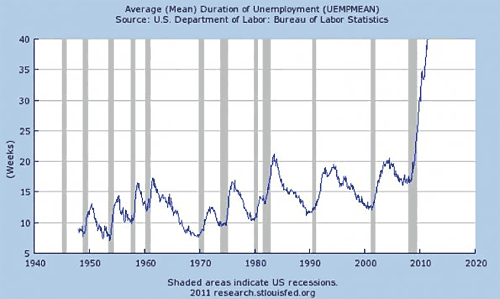
Scariest Jobs Chart Ever II

U.S. Average Duration of Unemployment

U.S. Average Duration of Unemployment

Even though we’re “creating jobs” each month, this would seem to point to a large, brewing, structural unemployment problem, with a significant chunk of the population permanently out of the workforce. Historically, we’ve never seen anything like this, and the fact that we only had one down-blip during the recovery is stunning.


woensdag 6 juli 2011

We're Number One: More Reasons for the Decline of the American Empire

You will not find today’s Daily Reckoning much to your liking. Because it creeps upon an idea that will probably make you feel uncomfortable. At least, that is the effect it has on us.

But first, the latest news from the world of money.

Yesterday, the Dow fell 12 points. Gold shot up $30. And oil is headed back towards $100.

Gold refuses to go down. Stocks refuse to go up. But over the last ten years, gold has gone up big-time, while stocks have gone nowhere.

Why? Because America topped out in 1999.

We went to church on Sunday. The church was built in the 1860s by a group of Maryland Episcopalian planters who were breaking away from a pro-Union parish. Physically, it is a marvelous example of ‘carpenter gothic’ architecture from the mid-19th century.

Since we had been living in Europe for the last 15 years, we had few opportunities to attend our local church. But it once played an important role in our lives. Our family went every Sunday, and your editor was an altar boy for several years.

So, he put on his Sunday-go-to-meeting clothes – coat and tie – on Sunday morning, returning to the church he knew as a child, and took his place in a pew in the back of the church.

The first thing he noticed was that he was the only one wearing a tie…or a coat. The rest of the congregation looked as though it was ready to order foot-long hotdogs or spread out beach towels. A man who must have been 55 years old came in a pair of baggy shorts – the kind you would normally dip in soapy water and use to wash the car. Over his broad stomach he wore an olive-drab tee-shirt of the sort worn by Tennessee auto mechanics. This was a level of informality we had never before seen in an Episcopal church. Or any church, for that matter.

We were reassured when the choir appeared at the back of the church. It looked normal. Clad in bright red and blue, traditional vestments. With the cross going before them. But wait…there were two flags flanking the cross. One was a flag for the Episcopal Church. The other was the stars and stripes of the USA. Politics and religion – the state and the church – marched side by side up the aisle, as the choir pumped out a joyful hymn.

This church had become very pro-Union! Later, the choir sang two patriotic songs – “God Bless America” and the purely securely “America the Beautiful.” Never before had we heard praises to Caesar sung in a church.

But it didn’t seem to bother anyone. Christ and Caesar, Caesar and Christ… Most people like to see them together; they are as happy serving one master as the other. They like it even better when they have two of them.

It didn’t bother us either. After all, the morrow was the 4th of July. Maybe they did this only once a year….

Meanwhile, on the Internet, a site called “Economic Collapse” anticipated the high spirits of Independence Day with a list of 20 “not-so-great categories” in which the US really is Numero Uno. Its author first assures us of his loyalty:

I love the United States. I love the American people.

Then, he opens fire:

America is like an aging, bloated rock star that has become addicted to a dozen different drugs. America is a shadow of its former self and it desperately needs to wake up before it plunges into oblivion.

If you do not believe that America is in bad shape, just read the list below. The following are 20 not so good categories that the United States leads the world in….

#1 The United States has the highest incarceration rate in the world and the largest total prison population on the entire globe.

#2 According to NationMaster.com, the United States has the highest percentage of obese people in the world.

#3 The United States has the highest divorce rate on the globe by a wide margin.

#4 The United States is tied with the UK for the most hours of television watched per person each week.

#5 The United States has the highest rate of illegal drug use on the entire planet.

#6 There are more car thefts in the United States each year than anywhere else in the world by far.

#7 There are more reported rapes in the United States each year than anywhere else in the world.

#8 There are more reported murders in the United States each year than anywhere else in the world.

#9 There are more total crimes in the United States each year than anywhere else in the world.

#10 The United States also has more police officers than anywhere else in the world.

#11 The United States spends much more on health care as a percentage of GDP than any other nation on the face of the earth.

#12 The United States has more people on pharmaceutical drugs than any other country on the planet.

#13 The percentage of women taking antidepressants in America is higher than in any other country in the world.

#14 Americans have more student loan debt than anyone else in the world.

#15 More pornography is created in the United States than anywhere else on the entire globe. 89 percent is made in the USA and only 11 percent is made in the rest of the world.

#16 The United States has the largest trade deficit in the world every single year. Between December 2000 and December 2010, the United States ran a total trade deficit of 6.1 trillion dollars with the rest of the world, and the US has had a negative trade balance every single year since 1976.

#17 The United States spends 7 times more on the military than any other nation on the planet does. In fact, US military spending is greater than the military spending of China, Russia, Japan, India, and the rest of NATO combined.

#18 The United States has far more foreign military bases than any other country does.

#19 The United States has the most complicated tax system in the entire world.

#20 The US has accumulated the biggest national debt that the world has ever seen and it is rapidly getting worse. Right now, US government debt is expanding at a rate of $40,000 per second.

The truth is that America has changed. Most of us don’t even say hello to our neighbors anymore.

The United States was once the most blessed nation on the face of the earth, but now we are literally falling to pieces.

Does anyone have any ideas about why this could be happening?

Well, yes. We do have some ideas. But don’t think for a minute that we’re going to give you earnest advice on how to make the country a better place. There are approximately a million civil servants who are paid to do that! You can see for yourself what a good job they have done.

No, we’re just going to explain how America became a country of fat poor people who – when they’re not watching TV – are murdering and raping their fellow citizens.

In fact, we already have. It’s in a book. About 5 years ago, with Addison Wiggin, we wrote Empire of Debt. We predicted how America’s imperial mission would evolve. And we said it was unstoppable. Forget the debt ceiling. Forget the budget cuts. Forget the idle ranting and raving, posturing and pretending…this Bozo is going bust! Congress has raised the “ceiling” so often – 94 times in the last 94 years, the Capitol might as well be an open-air building. We wrote:

“The imperial spirit has gotten the best of her. She no longer plays a role that she can understand and control. Now, she is an imperial power: she must read from the script that has been thrust in her hands. She must provide security for the entire world… Someone has to do it. It is her turn to wear the purple, whether she wants to or not. Thus did she become the dictatress of the world; but no longer ruler of her own spirit – or her own finances.”

Like a clown shot out of a circus cannon, America’s trajectory is fixed. Just look at the “Number 1” items above. They are the marks of an imperial power in decline. Overseas, the imperial garrisons squander her military might. At home, the masses degenerate, squandering her wealth.

And here’s the worst part: America will continue in this direction until she falls on her head.

More to come…

maandag 6 juni 2011

The US and The Five Stages Of Collapse

Interview on WMNF FM, Tampa, Florida

Some excerpts:
First you have financial collapse, which is basically the volume of debt that has to be taken on in order for the economy to continue functioning, cannot continue. We're seeing that right now in Greece, we're probably going to see that in Japan, we're definitely at a point now in the United States where even if you raised the income tax to 100 percent, there's absolutely no way of covering the liabilities of the U.S. federal government. So, we're at that point now but the workout of the financial collapse is not all quite there. We don't quite have a worthless currency but that's in the works.

That, of course, is followed by commercial collapse especially in a country like the United States that imports two thirds of its oil. A lot of that is on credit and if a little bit of that oil goes missing then the economy starts to fall apart because nothing moves unless you burn oil in the United States and, of course, a lot of goods that are sold everywhere are imported again, on credit. And then commercial collapse is generally followed by political collapse because the Congress no longer has the ability to spend money in the fashion to which they have become accustomed. Governments at every level start failing. We're seeing the beginnings of that where fire and police departments around the country are being cut. Right now there's a big fight over the retirement of retired municipal workers. Retirements are, basically, being looted in order to paper over these giant gaping holes in the finance scheme.
Then the last two stages are I think generally avoidable in most places which is social and cultural collapse. Unfortunately to my thinking these two stages have largely run their course in many places in the United States where people really don't know their neighbors and also they don't really do very much for themselves. They expect to be fed at fast food establishments, they don't know how to cook from scratch, and things like that. So, those are the five stages and a lot of people have found this sort of way of thinking useful in terms of understanding what's happening.
What do you see the United States looking like for Americans in the next 5 to 10 to 20 years?
I think the country will be unrecognizable in 10 years, I don't know about 5, but I don't think it will look like a country in 10 years. I think it will be largely dismembered by it's creditors.
Do you think that we're going to be going quickly or slowly into these different stages of collapse?
I think certain stages like the onset of fuel, transportation, fuel shortages will be very sudden. American society tends to be very fragile. People tend to bring shotguns and baseball bats to gas stations and then every thing goes down hill from there. I expect certain parts of the country to go through this cataclysm where suddenly everything that they depend on, which is basically their car, no longer works and everybody's stranded and very angry. It would be a lot of mayhem. We've already seen that, for instance, during Hurricane Katrina and afterward because of all the refinery problems the '..' pipeline that goes up from the Gulf, I think it ends up in New Jersey somewhere, it couldn't be filled so gas stations in places like North Carolina ran dry and I've heard from people in that area that basically civilization ceased to exist. And then, when gasoline supplies were restored civilizaton sort of came back. That should be the pattern in a lot of places in this country.
There's been some limited coverage of peak oil in the press recently, do you think it's enough to raise the level of awareness for people in this country about the things that you predict are going to happen?
Unfortunately a lot of people simply cannot be reached because they refuse to hear what we have to say. It's not that they can't understand it, it's that they refuse to listen. The media, in general, in the United States makes it very easy because there is this fictional reality that they perpetuate and foist on people that contradicts what we're saying. We're saying that 'this will not continue for very much longer, people'. And then the media says that 'everything is fine, everything is normal', and even the President is now in the game where he says completely nonsensical things like drilling in Alaska for oil will actually make a difference. He recently said that. It contradicts what his own government says about the amount of oil left there. Some of these just fictional feel good messages just saturating the media and so the reality based people really don't stand a chance.

Making the Best Use of Your Energy Elves

Presented on May 21 at the Northern California Eco-fest.

https://docs.google.com/present/view?id=dtxqwqr_209v3vm8rjn&interval=10&pli=1